Wednesday, March 18, 2015

Works by Fernando Zóbel from the Estate of Jim and Reed Pfeufer


Fernando Zóbel de Ayala (circa 1955)

On February 6th of this year, the Leon Gallery, located in Makati City, held an auction of 73 works of art by Fernando Zóbel de Ayala (1924-84). The article that follows, which was written for the auction catalog by John Seed, describes the friendship between Zóbel and Jim and Reed Pfeufer, from whose estate the works had come.


* * * 

“If I’m not mistaken I think I was six when I first met him (Fernando Zóbel). And through the eyes of a 6 year old it was all magic.” – Eric Pfeufer

For years, Eric Pfeufer, 72, has carried fond memories of Fernando Zóbel de Ayala (1924-1984), the Philippine/Spanish modern artist who befriended his family while a student at Harvard after World War II. Eric’s parents, Jim and Reed, served as mentors to the young artist, supporting his interest in art and providing him a home away from home.


The Pfeufer’s home, in Cambridge, not far from Harvard Square, was modest and decidedly Bohemian. The walls were filled with art, and Reed had painted on many of the home’s surfaces: a naked Adam and Eve appeared on the doors of the kitchen cabinet, with a snake peeking from between their legs. Zóbel was one of a number of young Harvard men — aesthetes, architects and intellectuals — who hung out at the Pfeufer home, where the cultured conversations often went late into the night.


After his graduation in 1949 Zobel returned to Boston periodically — to serve as a curator at the Houghton Library in 1951-2 and again to exhibit his work in 1954 — and during these visits he painted and drew both the Pfeufer parents and all three of their children.


Eric Pfeufer with his Zóbel portrait

Zóbel’s portrait of young Eric, created around 1953, is a 17” x 7” inch oil painting on masonite, that shows the young man as a knight with a red t-shirt, holding a winged helmet. It is a charmed image of boyhood that shows the artist’s respect and love for his young subject. That love and respect was mutual, as Eric remembers thinking of Zobel as a family member:

“I was just taken in by the, this miraculous person who just came and arrived and then became so close with the family. It was just a completely comfortable friendship.”

For Fernando Zóbel, who had grown up in a mansion in Manila, surrounded by the members of a wealthy, aristocratic family, the Pfeufers must have provided a very different kind of ambience: when asked for his political affiliation on a Harvard form Zóbel had entered “Monarchist.” The Pfeufers were down to earth, politically liberal, devoted to art rather than business, and far from affluent.


After marrying in the mid 1930’s Jim and Reed Pfeufer first lived in Plympton, Massachusetts. Both were used to frugality: Jim had been unemployed during the depression until he found a job supervising artists for the WPA. In 1941 the couple moved with their children Martha and Joachim to Cambridge where Jim took a position teaching shop classes at the Shady Hill School. Eric, the couple’s third child, arrived in the spring of 1942.


Jim and Reed Pfeufer

Jim Pfeufer, the grandson of members of the German Freethinkers movement who had settled in Texas in around 1848, grew up in Harlem and studied electrical engineering at the City College of New York. Jim was a jack-of all-trades, a clarinetist and a devoted father. Although he was not making art when Fernando first appeared, Jim later became a printmaker who taught at the Rhode Island School of Design.


Reed Champion was a native of Newton, Massachusetts, the daughter of a Yale graduate, Walter Julius Champion, and a musician mother, Alice Viola Champion. Raised in the Quaker tradition, Reed was taught to respect others and also that women were equal with men. Her mother, who was intensely creative, attended the New England Conservatory while Reed was a girl, also painted, had an interest in arts and crafts, and founded a theatre.


Reed’s father, a lover of the classics, read her Plato before she was five years old, and by the age of twelve she was steeped in myths, fairy tales, and the writings of Balzac and Hawthorne. Reed first displayed an interest in art while attending the Moses Brown School in Providence, Rhode Island. She later attended the Museum of Fine Arts School in Boston, where she studied with Wallace Harrison, an École des Beaux-Arts graduate and the architect of Rockefeller Center.


Reed was active as an artist during the war years, showing in group exhibitions at Boston’s Institute of Contemporary Art in 1943, and again in 1944 when her work was shown alongside that of Jack Levine and Hyman Bloom, two of Boston’s leading modern painters. Like other artist’s connected with “The Boston Style” both before and after the war, Reed was representational painter whose art leaned towards Expressionism.

For Fernando Zóbel, who started his career painting representationally, Reed’s paintings were touchstones and also a point of departure. In a 1958 letter addressed to “Dearest Reed”, Zóbel acknowledged the importance of her work:


“Your pictures seem so natural and alive to me that I find them hard to view as something separate. They are very much a part of me I know, and my own pictures, though they seem perhaps so very different, in some obscure way lean on yours, in my mind, for support and reflection.”

Jim played an important role in Zóbel’s life as well. After receiving letters describing the artist’s increasing dis-satisfaction with his life as a businessman in Manila, Jim — — who was serving as the head of the Graphic Design Program at the Rhode Island School of Design — arranged a short term position for Zóbel. It was during that visit that Zóbel had a life-changing experience: he visited a RISD exhibition of abstract paintings by Mark Rothko that fascinated him so deeply that he visited every day. Six months later Zóbel couldn’t get the paintings out of his mind. In his journal, he wrote: “I am awed by the way those huge colored squares refuse to be forgotten.” Although Zóbel had experimented with abstraction in the early 1950s, viewing Rotko’s work became the impetus for his first and most famous series of abstractions: the “Saetas.”


Reed Pfeufer and Fernando Zóbel in Cuenca, 1974

Throughout the 1960s, 70s and 80s, the Pfeufers kept in touch with Zóbel as his reputation and stature grew. Eric and his brother Joachim both spent periods of a month or more staying with Zóbel in Spain, and Eric was there when the Museum of Spanish Abstract Art — which Zóbel founded — was in its early stages. Jim and Reed came to Cuenca in 1974. Eric remembers one last visit with Zóbel at the Harvard club just a few years before his sudden death at the age of 60 in 1984. “When I was with Fernando,” Eric recalls, “it was just the joy of knowing him. He was always generous and focused on his painting.”


Since his parent’s deaths — Reed passed away in 1997, followed by Jim in 2001 — Eric has been tending their estate, which includes five Zóbel oil paintings. One of them, “Garden Window” (1953) shows Joachim’s trumpet perched in front of the window of the Pfeufer’s home. Besides the portrait of Eric there is a slender, four- foot high portrait of Joachim, and also a dark, comic portrait of Jim holding his clarinet. 


There is also “Nothing III” which features an expressively linear image of a man seated at a desk: it is a remarkable early Zóbel which was shown both in the artist’s 1953 exhibition and a 1954 show at Boston’s Swetzoff Gallery.

Earlier this year, Eric was visited by two Zóbel experts, Rafael Perez-Madero and Sheldon Geringer, both of whom were interested in seeing his Zóbel paintings. Stimulated by their visits Eric went through the flat files his parents had left in their home on Cape Cod and was stunned by what he found. Not only were there original Zóbel works on paper, prints and notebooks, but also a large abstract “Saeta” on paper. It was an unexpected treasure trove.


“It’s a joy to see Fernando’s work re-emerge.” Eric notes, “and a shock to me because my parents had flat files not only of Fernando’s work but of other people’s. I wasn’t every aware that these things were there.” Some or all of the prints were made in Jim Pfeufer’s studio in the basement of the Cape Cod house, where he assisted Zóbel with his printmaking. “Fernando had the benefit I would say of my father’s experience,” Eric points out. “My father had started as a painter himself and as time went by he became more engaged in etchings a various kinds of mediums.”


The treasured works that were part of Jim and Reed Pfeufer’s estate are a testament to an enduring friendship that revolved around art and love. In an undated letter written from Cuenca, Spain, Fernando Zóbel made a point of reminded the Pfeufers of the crucial role they had played in his life: “Much love to you. I think of you very often and I like you very much indeed. You have given color to my whole life.” 


Below: A 13 minute film about Fernando Zóbel and the Pfeufers

Thursday, February 28, 2013

Biography of Jose T. Joya, Philippine National Artist


JOSE TANIG JOYA (b. Manila, June 3, 1931 d. 1996)

Jose Joya
National artist Jose Joya was a pioneer modern and abstract artist who was active as a painter, printmaker, mixed-media artist and ceramicist. It has been said that it was Joya who "spearheaded the birth, growth and flowering of abstract expressionism" in the Philippines. His mature abstract works have been said to be "characterized by calligraphic gestures and linear forces, and a sense of color vibrancy emanating from an Oriental sensibility." Joya's sense of color has been said to have come from the hues of the Philippine landscape, and his use of rice paper in collages demonstrated an interest in transparency. 

Jose Tanig Joya was born on June 3, 1931, the son of Jose Joya Sr. and Asuncion Tanig. He began sketching at the age of eleven. At a young age, he became interested in studying architecture, but found that he did not have the aptitude for the math and science that architecture would require. While attending the University of the Philippines he was introduced to the paintings of Fernando Amorsolo, and began his study of painting. He was initially schooled in the traditional tradition -- in which the standards had been set by Amorsolo and Tolentino -- but gradually was influenced by American abstraction and by the emerging trends in Philippine modernism. He was mentored by Guillermo Tolentino, Ireneo Miranda, Domindaor Castaneda and Virginia Agbayani. 

Joya graduated from the University of the Philippines (UP) in 1953 with a Bachelor's Degree in Fine Art, earning the distinction of being the university's first Magna cum Laude. In 1954 the Instituto de Cultura Hispanica of the Spanish government awarded him a one year grant to study painting in Madrid. Travel/study scholarships to Madrid -- which came about through the influence of PAG member Fernando Zobel de Ayala -- were also given to other PAG artists including Arturo Luz, Nena Saguil and Larry Tronco. After returning from Spain, Joya finished his Master's Degree in Painting in 1956 at the Cranbrook School of Art in Michigan, with the assistance of a Fulbright Smith-Mundt grant. 

Above: The opening of a Jose Joya exhibit, featuring religious paintings, at the Philippine Art Gallery
Jose Joya (indicated in white) is 4th from the left. 

His early works were representational paintings that showed the influence of Vincente Manansala and Anita Magsaysay-Ho. During the late 1950's, as he became involved in the Philippine Art Gallery -- founded in 1950 by a group of women writers led by Lyn Arguilla -- he became one of the "new wave" of artists who developed abstract paintings. His first one make show appeared at the Philippine Art Gallery in 1954, and in March of 1958 he won first prize for his non-objective "Painting" in the 11th Annual PAG Art Exhibition, held at the Northern Motors Showroom. He won more prizes in 1959 (Second place for "Space Transfiguration), 1960 (Third place for "Horse of Life) and 1962 (Third place for "Cathedral). 

Jose Joya, "Untitled," 1960, approx. 16 x 24 inches, oil on canvas 

Joya was often present a the "Saturday Group" which met for weekly art discussions at the Taxa de Oro Restaurant in Manila. In 1962, when Joya was serving as the President of the Art Association of the Philippines, he and Napolean Abueva represented the Philippines in the prestigious Venice Biennale: it was the first time that the Philippines had participated. He displayed a 1958 horizontal abstraction titled "Granadian Arabesque," a painting which features powerful swipes of impasto mixed with sand, and which is now in the collection of the Ateneo Art Gallery. Joya later wrote about participating in the Biennale, and reported on the novelty, desire to shock and "dazzle" of the work on view. 

Side view of the impasto of Joya's "Granadian Arabesque"

In the late 60s received grants from the John D. Rockefeller III Fund and the Ford Foundation, which allowed him to paint and study at the Pratt Institute in New York between 1967 and 1969. Among the positions he held were:

- President of the Art Association of the Philippines (AAP) 1962-65
- Dean of the UP College of Fine Arts 1970-78, where he modernized curriculum and established scholarships.
- Chairperson of Philippine Delegations to China, 1961 and 1972 

In the 1970s Joya executed two large murals, "Lanterns of Enlightenment" and "Mariveles" which display vivid interplays of shape and tone. When traveling overseas he often made rapid, on the spot sketches in pencil, charcoal or pastel. 

Joya was also a holder of the Amorsolo Professorial Chair in UP in 1985. He served as chairperson of the National Committee on Visual Arts, of the National Commission on Culture and the Arts from 1987 until his death. 

In 1981 a retrospective of some 200 of Joya's works was held at the Museum of Philippine Art. In1987 the French government awarded him membership in the "Order of Chevalier des Arts et Lettres." 

Jose Joya, "Makiling Interlude," 1984, Acrylic and Collage on Paper, approx. 22 x 15 inches

“In creating an art work,” Joya once stated “the artist is concretizing his need for communication. He has an irresistible urge to reach that level of spiritual satisfaction and to project what he is and what he thinks through his work.”

Joya died in May of 1995 at the age of 63 after complications from a prostate operation.
In 2003, eight years after his death, he was conferred the title of National Artist for his pioneering efforts in developing Filipino abstract art. A retrospective of his work was held in August of 2011 at the National Museum.

Monday, January 14, 2013

Roland Strasser: Artist and Adventurer

Painting by Roland Strasser 

ROLAND STRASSER (Austrian, April 24,1895 - July 27, 1974)

Roland Strasser, an Austrian painter of Basque descent, was born in Vienna in 1895. He was one of the great painter/adventurers of the early 20th century, and one of the last Orientalist romantics. His energetic paintings and drawings captured and portrayed the lives of subjects from regions and cultures still considered “exotic” by European viewers of the era. Once described by an admirer as “a strange, restless painter, who disappears for years…” Strasser was known for painting subjects that were difficult or even dangerous to paint.

Strasser first studied art with his father – whose family name was Quiriqez -- a member of the Viennese Sucession movement who taught at the Academy of Fine Arts and was known for his small scale polychrome ceramic sculptures and also for a bronze of Marc Antony that he created for the 1900 Paris World Exhibition. Strasser’s older brother Benjamin was also a painter and graphic artist. At the age of 17, after completing his studies at a Realschule, Roland Strasser accompanied his father on a trip to Egypt.

Strasser next studied with Rudolf Jettmar and Julius Schmidt at the Vienna Academy of Fine Arts between 1911 and 1915. He was then assigned as war artist for the Imperial War Press. Roland then briefly worked as a lithographer and illustrator. In 1919 he traveled to Holland where painted at Volendam and earned enough money selling paintings to be able to travel the following year.

In 1920 Strasser traveled first to Siam (Thailand), then Java (Indonesia) and finally New Guinea. Along with another adventurer – whose intention was to shoot exotic birds – Strasser journeyed to the remote and forbidding interior of New Guinea. After being abandoned by his companion he spent four months in a Papuan village. He eventually made his way back to Java, but all of his drawings were lost. He then spent eighteen months at Bali where he met Willem Dooyewaard, a Dutch artist, who became his student and frequent travel companion.

In the autumn of 1922 Strasser traveled to Peking, and from there to the province of Shansi, where he made studies of peasants. He the continued on to Mongolia, and by 1924 was in the province of Szetshwan and finally the mountains of Tibet. As an artist, he used his rendering skills to render activities, postures and psychological states of his subjects. The works he made during this trip – both drawings and paintings – were shown in London by a Mr. W. B. Patterson, and the proceeds from their sale provided Strasser with funds for his next trip.

Strasser traveled through Bombay, Nagpur and Calcutta, then into the foothills of the Himilayas where he planned another trek into Tibet. At Kalimpong he assembled a caravan, and in January of 1925 he crossed the Kula Pass, and 10 months later reached Urga (now Ulaanbaatar) in Mongolia. After spending a year in Urga, Soviet authorities arrested Strasser as a spy. His diary and maps were confiscated, but he was allowed to keep his paintings and drawings.

In the winter of 1926 he travelled through the Gobi desert into China. He then took a train to Peking where all of the drawings he had made in Tibet and Mongolia were pillaged and destroyed by the troops of General Chang So-ling. Strasser travelled next to Tientsin, and then to Japan where he visited Kobe and Kyoto. Eight months later he took the Trans-Siberian railway to Vienna to visit his ailing father. After his father’s death in October, 1927 he remained in Europe and was the subject of an exhibition at the Berheim Jeune Gallery in Paris in February, 1928.

In 1930 he published "The Mongolian Horde," an account of five years of his travels in China and Mongolia, with 21 sketches included. In the foreward to his book, Strasser wrote:

“During five years of wandering in the heart of Asia, I accepted my experiences and impressions like such a child…But now that it is over, I feel the impulse to note down and retain, while they are still vivid, some at least of the strange and thrilling impressions that crowd upon me, in the shape of a few descriptive and open sketches.”

After additional travels, Strasser returned to Bali in 1934 where he stayed until 1944.
For years he had a studio in Kintamani above Lake Batur. He disliked visitors, and would leave his studio through a secret back door when not in the mood to entertain visitors. 

Roland Strasser died in Santa Monica California on July 27, 1974.

Sunday, November 4, 2012

Hubert Vos: Painter of China's Dowager Empress Cixi

The Dutch born painter Hubert Vos, who attended the 1893 Chicago World's Fair as a Deputy Commissioner for the Netherlands, had an epiphany at the event which would change the course of his artistic career. He later wrote:
It was during the World’s Fair in Chicago, where the officials had brought together the greatest collection of the different people of the Globe ever reuninted in one spot at tremendous expense, that I began to study the works I could get hold of on Ethnology and was shocked to see what poor specimens the principal authors had, to illustrate their very superior works. I thought it might be possible to establish a type of beauty of the different aboriginal races before they became much too mixed or extinct and soon got to work. works. I thought it might be possible to establish a type of beauty of the different original aboriginal races before they became too much mixed or extinct and soon got to work.
 Although Vos continued to support himself with portrait commissions after the fair, he became increasingly known as a painter of ethnic types. In 1897 he spent eight months at Fort Totten, North Dakota, painting Native Americans. After that, travels to Hawaii, Korea, Japan, and Hong Kong followed. In 1899, a few months before the outbreak of the Boxer Rebellion, he was in China where he painted a variety of figures including a young man who would later become the first president of China. Vos asked to paint China's empress dowager, but his request was turned down and he returned to the U.S.


 Hubert Vos: Self-Portrait, 1922

About 40 of the ethnic portraits made by Vos during his travels in Asia were exhibited at the Union League Club in New York and the Corcoran Gallery of Art in Washington, DC, as well as at the Paris International Exposition of 1900. Perhaps because of his background in painting society portraits, Vos' portraits of Asian subjects tended to endow them with a certain glamor and dignity. One critic described his portraits as "delicate, smooth, and accomplished.”

Through the efforts of Sarah Conger, the wife of the American envoy to Beijing, the American artist Katherine Carl was invited to Beijing in 1903 to produce a portrait of Empress Cixi for the upcoming 1904 Louisiana Purchase Exposition. Carl spent many months created a flattering life-size portrait that measured over nine feet tall. The finished work was shipped to St. Louis accompanied by a large retinue of Manchu officials where it had a prominent place in the exhibition.

Katherine Carl: Portrait of the Empress Cixi, 1903-4

In 1905 Vos, now an American citizen, returned to China and was given the opportunity to become the second American to paint the dowager empress. Cixi, who had been on the throne for 40 years when Vos arrived, was a notorious figure who had been much gossiped about in the west. It was whispered, for example, that she had poisoned her nephew and had his favorite concubine thrown down a well. Vos had to appear at court at 5 a.m. to meet her, and was given only four brief sessions in a studio on the top floor of a Beijing hotel. In his letters he later related his impressions of his subject:
Erect, with a tremendous will power, more than I have ever seen in a human being. Hard, firm will and thinking lines, and with a brow full of kindness and a love for the beautiful. I fell straight in love with her.

 Hubert Vos: The Dowager Empress Cixi (Tzu Hsi), 1906 
On display at the Summer Palace, Beijing

Vos ultimately painted two portraits of the Empress, who was 71 years old. In Vos' portraits she looks considerably younger, and the artist reportedly enlarged her eyes and plumped her lips at Cixi's request. One of the portraits is in the collection of Harvard University while the other, larger image has remained in China. That version was severely damaged in the 1950s, and was recently restored by a group of experts from the Dutch province of Limburg. It was put back on public display at the Summer Palace in November of 2008.

In August of 2011, Hubert Vos' grandson -- Hubert D. Vos -- donated six Vos portraits of Chinese subjects to Beijing's Capital Museum. They depict statesman Li Hongzhang, warlord Yuan Shikai, Prince Yi Kuang, a Manchu boy, the daughter of an official of the Fujian navy, and a Suzhou girl from an aristocratic family.

Mr. Vos told a Chinese news reporter that although he cherished the pictures very much "I think they should return to their birthplace."

Links:


Hubert Vos: The Empress Dowager of China, Cixi (1835-1908) Harvard Collections


Tuesday, October 23, 2012

ManilART is a Growing Event

 In the New York based art blog Hyperallergic, blogger Carren Jao reports on the growth and diversity of the Manilla based annual art fair "ManilART," which ran took place earlier this month.

Chao notes that:
The event has grown tremendously, with 43 participating galleries and 11,700 people passing through the halls this year (compared to 6,000 last year). From a modest tent area it has now transferred to the sprawling SMX Convention Center (the largest trade venue in the country).
Learn more about ManilArt by reading the Chao's complete blog here.

Monday, October 1, 2012

Remembering Anita Magsaysay-Ho (1914-2012)

From the Geringer Art biography archive, a biography of the late Anita Magsaysay-Ho: 


Above Painting by Anita Magsaysay-Ho

ANITA CORPUS MAGSAYSAY-HO (Philippine, b. May 25, 1914, d. May 5, 2012)

aka Anita Magsaysay, Anita Magsaysay Ho 

Styles: Philippine Modern, Neo-Realism

Subjects: Philippine genre scenes, landscapes, harvest and market scenes, female nudes

Anita Magsaysay-Ho was a Philippine painter, considered by many to be one of the most important and gifted Philippine modernists. In 1958, a panel of experts assembled by the Manila Chronicle named her one of the 6 most outstanding painters in Philippine history.  Magsaysay-Ho’s best known canvases, which often have both realist and stylized aspects, celebrate the beauty of Philippine women engaged in everyday tasks. 

Magsaysay-Ho was born in Manila in May, 1914, the daughter of Ambrosio Magsaysay, an engineer, and Armilla Corpus. Anita’s first cousin, Ramon Magsaysay, served as President of the Philippines from December of 1953 until his death in a 1957 plane crash. Beginning her studies at the University of the Philippines School of Fine Arts at the age of 13 -- accompanied by a nanny -- she studied with Fabian de la Rosa, Vicente Rivera y Mir and also Fernando and Pablo Amorsolo. Fernando Amorsolo was her landscape teacher, while Pablo Amorsolo taught her drawing. 

She also received private tutoring from the noted cartoonist Ireneo Miranda. She recieved additional instruction at the UP’s School of Design where her instructors included Victorio Edades and Enrique Ruiz, and at the "Atelier of Modern Art" founded by Edades. 

In the 1930s Anita Magsaysay travelled to the United States where she continued her studies at the Cranbrook Academy in Michigan. Anita also took courses in oil painting, and drawing at the Art Student’s League in New York City. While in New York, Anita met her future husband, Robert Ho, who was also a student. After their marriage, he bought postwar ships in the United States and brought them to China where he established a shipping business: Magsaysay Inc. Because of her husband’s work, the Hos and moved frequently, living in Brazil, Canada, Hong Kong and Japan. Anita, who has moved over 40 times in her lifetime, was soon raising 5 children. Anita was painting whenever possible, and always had a home studio where her children would sketch, play the piano and listen to music while she painted. 

During the early 1940s Magsaysay - Ho's works showed the influence of Fernando Amorsolo both in their subject matter and their luminosity. Gradually, her paintings evolved towards modernism as they moved towards cubist distortion and evolved stylized visual rhythms. She was included on a list of “Thirteen Moderns” compiled by artist Victor Edades, and was at one point known as the "female Amorsolo." 

In the 1950s Magsaysay-Ho exhibited at the important Philippine Art Gallery (PAG) which brought her public attention and acclaim. Her work was grouped with that of other Neo-Realists including Lydia Arguilla and Nena Saguil. Anita’s paintings of this period featured women at work: harvesting fruit, gathering and sheaving grain, or selling fish in the marketplace. Her works were formally activated by bold brushwork and strong contrasts of dark and light tones. 

 In the 1960s the space of Magsaysay-Ho’s paintings opened up and the resulting images were more relaxed, with clearly articulated and separated figures. The lines in her work softened, and her modeling became more consistent. These paintings have the feeling of being choreographed, and are very graceful in their effect. 

In the 1970s Magsaysay-Ho explored a new style influenced by Chinese calligraphy. Her paintings were often decorated with delicately controlled ink blots that suggested rock formations, vegetation or waves. At their best, they balanced human gestures with the calligraphic interest provided by the ink blots.
In the late 1980’s the artist had a “Green Period.”  Green-hued fruit and vegetables mingle with female figures that seem to resemble plants or fruits themselves. The women in these paintings feature oval faces with high cheekbones and narrow eyes. 

Another series that followed the green paintings featured half figures surrounded by baskets, fruit and birds. These figures are solid and highly refined, rendered in an Asian palette that counter-balanced stark contrasts between colors such as burnt sienna and yellow-green. 

In her nineties Magsaysay-Ho became the subject of a biography by Alfredo Roces, “In Praise of Women,” published in 2005. She states, in the text; “In my works I always celebrate the women of the Philippines. I regard them with deep admiration and they continue to inspire me—their movements and gestures, their expressions of happiness and frustration; their diligence and shortcomings; their joy of living. I know very well the strength, hard work and quiet dignity of Philippine women, for I am one of them.”

After suffering a stroke in 2009 Magsaysay-Ho stopped talking. One day, regaining her speech, she called her husband and told him "Robert, you are the only man I ever loved in my life."

Awards:
2nd Prize: The Manila Grand Opera House Exhibition, 1950, for “Five Senses”
1st Prize: The Philippine Art Association (PAG), 1952, for “The Cooks”
2nd Prize: The Philippine Art Association (PAG), 1953, for “Fruit Vendors”
1st Prize: The Philippine Art Association (PAG), 1959, for “Mending the Nets”
1st Prize: The Philippine Art Association (PAG), 1960, for “Two Women”
2nd Prize: The Philippine Art Association (PAG), 1962, for “Trio”

Collections:
The Ateneo Art Museum, Ateneo de Manila University, The Philippines
The Lopez Memorial Museum and Library, Pasig City, The Philippines
The Metropolitan Museum of Manila, The Philippines
The Yuchengo Museum, Makati City, The Philippines

Saturday, September 22, 2012

Fabián De La Rosa and His Times

Part one of a 14 minute video, produced by Filipiniana.net, in cooperation with the UP Vargas Museum, which traces the life and career of the internationally-acclaimed 20th century Filipino master Fabián De La Rosa. De La Rosa's rightful place in Philippine art history has often been obscured by his more illustrious predecessors, Juan Luna and Felix Resurreccion Hidalgo, and his famous protégé and nephew, Fernando Amorsolo.

Sunday, September 2, 2012

Ambeth R. Ocampo on Fernando Amorsolo


On September 8th at 3PM, Professor Ambeth R. Ocampo of Ateneo de Manila University will present "Fernando Amorsolo: Portrait of the Artist as Historian." Professor Ocampo is known for his unique blend of academic rigor and wit.

Each lecture is P300 for adults and P200 for students, senior citizens, and Ayala Museum members. The cost includes a copy of an Ambeth Ocampo book and full admission to all museum galleries.

Ayala Museum is at the corner of Makati Ave. and De la Rosa St. in Greenbelt Park, Makati City. For information on this series, call 757-7117 to 21 local 29, e-mail education@ayalamuseum.org, or visit www.ayalamuseum.org.

Tuesday, August 14, 2012

China's Art Market and Fraud

In a recently posted article on Forbes.com, writer Abagail R. Esman asserts that China's art market -- the world's largest -- is rife with fraud and deception.

Among Esman's assertions:

- Many major purchases at China's auction houses are defaulted on, and never completed.

- Artificially inflated purchase prices and manipulated sales have distorted the market

- Sellers are covertly allowed to bid, often in a process designed as a bribe

If Esman is correct that over 80% of the prices paid at Chinese art and auction sales are tainted, it is likely that price estimates across the globe have been altered as a result. Add to this the problem of fakes and forgeries -- always an issue in the Chinese market -- and you have some idea of the complications found in the market for both antique and contemporary Chinese works.

For the complete text of Esman's article, click here. 

Monday, August 13, 2012

Arman Manookian: Fragile Paradise

Originally published in Honolulu Magazine. 

Posted here with the permission of the author, John Seed


A. T. Manookian, "Hawaiian Boy and Girl"
One of a series of mural paintings originally installed in the "Green Mill Grill."

From the Honolulu Advertiser, May 12, 1931:

Brilliant Young Artist is Suicide Arman T. Manookian Takes Poison During Social Affair


"Inquest into the death of Arman T. Manookian, 27, well-known in Honolulu and certain Mainland circles as an artist of distinction will be held some time this week, according to Deputy Sheriff William Hoopai, coroner. Death, according to Dr. Robert Faus, was due to poison.

Manookian died at 10:15 o'clock Sunday evening at the Queen's Hospital where he had been removed after he had taken poison at the house of Mr. and Mrs. Cyril Lemmon, ...Black Point Road, where he had been living for several months.

The artist had refused to take part in games being played by a group of guests at the home, and had gone to his room...

No reason for the artist could be offered by his friends. He was said to have been despondent for several days prior to his taking poison."


Arman Manookian

When Arman Tateos Manookian died he was more than 8,000 miles from his birthplace of Constantinople (Istanbul), Turkey. Why Manookian chose to die in a place that he found to be a paradise is a secret that he took with him to his grave. What he left instead was a dazzling public legacy: his art. In the five years and eleven months that he lived in Honolulu he produced paintings, magazine illustrations and, most impressively, murals that in the words of Art Historian David Forbes "were completely unlike anything that Honolulu audiences had previously seen."

Manookian was a complex man, a hero of Hawai'i modernism, who himself objected to his work being called "modern." The best way -- indeed the only way -- of understanding him as a man is to consider the fragments of his life, and set them against the background of history. The rediscovery of a cache of lost Manookian drawings from the estate of Maj. Edwin North McClellan, the man who brought Manookian to Hawai'i, has helped bring his development into focus.

Manookian, the eldest of three children, was born on May 15, 1904 in Constantinople, the troubled heart of the collapsed former Ottoman Empire. His given name, which he used until joining the U.S. Marine Corps was Tateos (Tady to his family), which is Armenian for the Apostle Thaddeus, one of the two Apostles credited with bringing Christianity to Armenia. Manookian came from a family of Armenian Apostolic Christians, and his father, Arshag, was a printer and the publisher of an Armenian newspaper.

The Manookian family was one of the Europeanized Armenian families that had held on to their status and affluence despite crippling taxation and the political dominance of the Islamic Turkish Pashas. They were the cultural elite of the Armenian nation, learned, prosperous and proud of their 3,000 year old culture.

The Armenians, the first nation to convert en masse to Christianity in 301 A.D. , were a religious and ethnic minority in Turkey, trying to preserve their language and culture in a hostile environment. For centuries, their Turkish overlords had subjected them to relentless oppression and violence. In 1912, British writer W. Llewellyn Williams recalled that:

"Even at the beginning of the 19th Century, at Constantinople, a Mussulman could very well stop a Christian in the street, and calmly behead him, in order to test that his sword was in good condition."

This random violence, however, was a token compared to the terror that would shatter the lives of Armenians from 1915 to 1918. One million or more Armenians would be murdered during a genodical rampage systematically planned by a group of nationalistic leaders known as the "Young Turks", with German military advisers looking on. Henry Morgenthau, the American ambassador to Turkey from 1913 to 1916, tried unsuccessfully to intervene on the side of the Armenians. He was later to write:

"I am confident that the whole history of the human race contains no such horrible episode as this. The greatest massacres and persecutions of the past seem almost insignificant when compared with the sufferings of the Armenian race in 1915."

The Armenian genocide remains one of the most chilling moments of the early 20th century, a prototype for other horrors to follow.

The terror came to Constantinople on April 24, 1915, just shy of Manookian's 11th birthday. On that day, 600 Armenian intellectuals, writers, poets, politicians and others were gathered up and murdered. Manookian's father managed to hide himself and his brother-in-law in the family print shop and survived. Within weeks, perhaps 5,000 more men were dead, some killed in death marches into the desert.

At the time of the terror, Tateos was a student at the school of St. Gregory the Illuminator, a branch of the Armenian Mekhitarist Brotherhood of Venice. The 31-year old principal of his school, Daniel Varoujan, was a leader in the Mehian movement, which was an attempt to generate an Armenian cultural renaissance. In late April, 1915, he was arrested and tortured, later to be executed in prison. The death of their school principal must have been one of the countless losses that shattered the lives of Tateos and his classmates that April.


Daniel Varoujan


The next years in Constantinople were a hell of whispered threats and public executions, set against the spectacle of destitute Armenians streaming in from the countryside. The Manookians held on in Turkey as long as they could, and Tateos later told friends that he had spent some of this time in Egypt. His father, Arshag, was forced to leave the family and make his way to safety in France.

Ironically, Arshag Manookian escaped the genocide in Armenia only to die in France. In 1917, he caught the Spanish flu, one more victim in an epidemic spread by returning soldiers, that killed more than 20 million people worldwide. Tateos, a strong-minded teenager whose relationship with his mother was strained by grief, felt the heavy weight of taking over his father's place in the family business resting on his shoulders. His mother, who managed to sell the family business, made the extraordinary gesture of giving her eldest teenage son a large amount of money, allowing him the chance to live out his dream of leaving for the United States.


The Re d'Italia


When he arrived on April 20th, 1920, disembarking from the Re d'Italia at Ellis Island, Manookian's sense of being foreign and lost in a Diaspora may have been intense. In 1918 alone, more than 50,000 Armenians had flooded into Ellis Island, many of them orphans. The sufferings of the Armenians were well known in the United States. President Herbert Hoover wrote in his memoirs:

"Probably Armenia was known to the American school child in 1919 only a little less than England ... of the staunch Christians who were massacred periodically by the Mohammedian Turk, and the Sunday School collections of over fifty years for alleviating their miseries. . . ."

Tateos went to live with a relative of his mother's, an umbrella repairman named Leo Stepanian who had a shop at 456 Washington Street in West Providence, Rhode Island. Providence at that time had a population of nearly 8,000 Armenians, many of them working under hazardous conditions at local foundries and the Hood Rubber Plant. Tateos had arrived during a post-war economic slump that lasted from 1919 to 1924 and Armenians were competing for jobs against a the background of a general resentment of immigrants.


The Rhode Island School of Design


"Tateos Manookian" appears as a night student at the Rhode Island College of Design in September of 1920, and he continued as student through the 1921-22 term. Manookian's talent must have been already apparent, as his tuition to take classes in "Freehand Drawing" was paid by a state scholarship. During his second year at RISD he took instruction in "Commercial Illustration" passing with high marks. By 1923 he had moved out (his address in the 1923 Providence Directory is the address of the YMCA) and was advertising his skills as a lithographer.

On October 8, 1923 he enlisted in the Marine Corps as "Arman Theodore Manookian" claiming U.S. citizenship which he did not in fact have. Although he did write to his sister that he had joined the "Army of the Navy." At just under five and a half feet tall, 132 pounds, with a newly shaved head that accentuated his ears, Manookian was not an imposing new Marine, but he had achieved a new identity as an American.


Private A. T. Manookian, from a Boot Camp photo, c. 1923


Major Edwin N. McClellan, Marine Historian, drawn by A. T. Manookian

Published in "Paradise of the Pacific" Magazine, December, 1927


On Nov 7, 1924 Private A. T. Manookian was assigned as a clerk to the office of Edwin North McClellan, an active Marine historian. When Private Manookian entered his office, McClellan, aged 43, had already served nearly seventeen years in the Marine Corps. For the past five years he had worked in the Historical Division of the Marine Corps, preparing a history of the Corps during World War I. The young illustrator had walked into the life of a man would publish more than 100 articles on Marine history, and, eventually, complete an epic history of the Corps, with 1,063 pages of text, (not to mention 836 pages of notes) and over a hundred illustrations, all carrying Manookian's monogram "ATM" .

As a young man, McClellan's military assignments had taken him all over the world, including a remarkable tour on the USS Wisconsin as part of the "Great White Fleet" that Teddy Roosevelt used to display American Naval prestige from 1908 to 1909. During that tour, McClellan got his first glimpse of Honolulu, along with ports in Australia, Japan, the Philippines, China and Egypt, traveling more than 29,000 nautical miles. His writing talents emerged in an unlikely context. While juggling military service and his studies at George Washington University Law School, McClellan wrote for both the "Index-Digest of Court Martial Orders" and the "Naval Digest".

Called to serve on the USS Arizona in February of 1917, McClellan was awarded the rank of Major and finished his World War I service on the USS Minnesota, briefly visiting France to begin collecting historical data on the War. Upon his return to Washington, McClellan completed and published his first "concise history" of the Marines in World War I, remarkably short on illustrations, at just about the same time that Tateos Manookian began his drawing classes in Rhode Island.

Manookian showed McClellan recent sketches he had made during a military exercise on the Puerto Rican Island of Culebra. McClellan must have appreciated those sketches as several of them remained in his estate at the time of his death. Perhaps McClellan, needing an illustrator, had also seen the decorative sketches that Manookian had contributed to the August 1924 issue of "Leatherneck" magazine, in which McClellan had first published an article titled "With the Marines in China" on January 30th.

For Manookian, it was a lucky break to have a military assignment that would let him use his artistic skills. McClellan, with his literary and historical interests, would also prove to be a mentor and father figure for the young Armenian.

Manookian was busy right away, developing pen and ink sketches for his superior's historical articles. Many of these survive at the Marine Historical Center in Washington D.C. They are penned on Royal-Crest Illustration board, touched up with white corrections, and labeled "sketched by PFC Arman Theodore Manookian".

Soon Manookian's work was appearing on the cover of "Leatherneck", first on October 18, 1924, and again for the May 16, 1925 issue, for which he created a multi-paneled design of graphics and historical vignettes. Around the same time, he painted an oil portrait of McClellan's young son Donald (now lost) and sketched an ink portrait of McClellan from a photo.


Manookian decorations from Leatherneck, August 1924


Manookian Self-Portrait Sketch from Leatherneck, October 1924


"Men in an Outrigger Canoe Headed for Shore"

48 x 68 inches

Mural from the Green Mill Grill", circa 1928


"The Water! Bright Blue! Deep purple! Varying Green! The suddy fringe draped over the reef's dark teeth-virgin white like the peeking lace on milady's lingerie. The reef's sharp fangs-the guardian bulwark of Waikiki. Fair, for as it bares its tusks up flares the warning white froth and foam."

From "Waikiki at Noon" by Edwin Mc Clellan, Published in "Leatherneck", October 1926


When McClellan was dispatched to Pearl Harbor, Hawai'i , on June 1, 1925, he took his talented clerk/illustrator with him. As Manookian prepared to leave the East Coast for Pearl Harbor, he was conscious of just how far he was about to travel from his past and from his Armenian friends and identity. He ended a May 23, 1925 letter to Menou Tufankjian, a childhood friend who was now also in the U.S:

" Who knows, perhaps I'll never see you again. Yours, A. T. Manookian"

It was a prophecy that would come true.

Manookian and McClellan may have been from tremendously different backgrounds, but the paradise of Hawai'i fired the creativity in both. Hawai'i was a long voyage from anywhere, and the ambience was magical. It was in Hawai'i that Manookian would transform himself from an illustrator to an artist, and McClellan the historian would be inspired to poeticize and mysticize his writing.

To be stationed at exotic Pearl Harbor must have been a dream, both artistically and socially. In describing Marine life there, McClellan told Leatherneck in 1926 that:

"...it is but a short trip to Honolulu, with its show-houses, its beaches, its well lighted streets with their cosmopolitan throngs...the worst grouch of all cannot but succumb to the soothing magic of a few hours spent with congenial companions under the glory of Hawaii's wondrous moon."

For young Marines like Manookian, there was more than the moon to appeal to the senses. Despite prohibition, there was sake being served in Japanese "teahouses" and Hawaii's own homebrew, Okolehao, made from ti leaves and compared by some to the best French brandy, was a prohibition era staple. Prostitution was officially illegal, but the red light district on Honolulu's River Street flourished, and the Army made health inspections. The young Armenian was in a landscape he found fantastic, living near a city bustling with growth and vice.


Manookian's cover for "Pearl Harbor Weekly," December 1926


Madge Tennent, the doyenne of Hawaiian art, once stated that she envisioned the Hawaiian kings and queens as "having descended from gods of heroic proportion, intelligent and brave, bearing a strong affinity to the Greeks in their legends and persons." This statement also perfectly expresses Manookian's approach to Hawaiian culture. This lofty idealization soon became apparent in the historical and mythological images of Hawai'i that he created to accompany McClellan's pieces, which were soon being published in Paradise of the Pacific.


Maui Snaring the Sun, pen and ink, circa 1927


In a stunning illustration commissioned by McClellan, but never published, the Hawaiian myth of "Maui Snaring the Sun" is presented in these ideal terms. The almost Grecian figure of Maui, set against a vista of Olympian clouds, reflects a new artistic grace that Manookian would characterize his Hawaiian paintings.

In a short profile of the artist, published in "Paradise of the Pacific" Magazine in 1927, Manookian states grandly that "in all his travels he has come upon no more intriguing artists' paradise than these mid-Pacific gardens of the Gods". Identifying himself as having come from "Byzantium... the eastern capital of the Roman Empire", Manookian states that he "fails to understand why the beaches of the Hawaiian Islands are not thick with the easels...of at least half the artists or would-be artists of the world."

By the time Manookian was discharged from the Marines in 1927, he had made up his mind to stay in Honolulu. He had not been given a recommended promotion to Sargent that had been dangled in January of 1927, but he did leave the service as a Corporal, and the recipient of a "Medal of Good Conduct." On September 5 he filed a Waiver of Transportation stating that would not be returning to the Mainland. In his waiver application he referred to a "lucrative" job as an illustrator that he had taken with the Honolulu Star-Bulletin, whose art director at the time was the artist John M. Kelly.

As Manookian settled into his new life as a civilian, several changes took place. His mentor, Edwin Mc Clellan was called to the Pacific Coast in November of 1927, and then to Nicaragua. He managed to keep up his duties as Editor of "Paradise", even though it would be nearly ten years before he actually returned to Hawai'i as its editor.

As McClellan and the Marines faded as influences in Manookian's life, tremendous new ideas and opportunities were appearing. In April of 1927 The Honolulu Academy of the Arts opened, and with its opening came lectures and programs. Did Manookian hear Madge Tennant give her series of November 1927 lectures on art, drawing and the use of color? If he didn't, its hard to believe, given his next artistic projects, that he would have missed a lecture by Madame Claude Riviere from Tahiti on the work of Gaugain, held the same month.

By 1928 he had moved to Makiki, less than a mile from the Academy. Becoming a member of the Honolulu Artist's Association, he attended meetings with Madge Tennent, Lionel Walden, D. Howard Hitchcock and other important Hawaiian painters.

Socially, Manookian may have found Honolulu similar to Constantinople: both were port cities where immigrant groups clustered with people of their own culture, hanging on to familiar lanuage and customs as best they could. In the islands, Manookian became friends with a Greek, George Geracimos, who owned the "Green Mill Grill" on Bethel Street, across from the Hawai'i Theatre. Bethel Street at the time was a kind of Bohemian transition between the bustle of Chinatown to the west and the dignity of the Iolani Palace district to the east. Restaurants like the "Green Mill", and its neighbors "Chez Parisien" and the "Monte Carlo" modeled themselves on Parisien brasseries, even if the alcohol had to be kept under the counter.

Trading work for meals and booze, it was for the "Green Mill" that Manookian made some of his most famous works, a series of oils that depicted Hawaii in the era of Captain Cook. Many of the restaurants patrons came in late after leaving the Hawaii theater. They would have just watched a show beneath Hawaii's most ambitious mural, the 35 foot wide "Glorification of Drama" completed by Lionel Walden in 1922.

What a shock the Manookian paintings must have been when compared with the pastel, Neo-Classical composure of Walden's work. In fact, the eventual buyers of the Green Mill Grill paintings were two Honolulu society women who first saw them when they dropped in after leaving the theater.


A. T. Manookian, "Red Sails", Collection of John and Patsy Dilks


The five Manookian canvasses presented a world of striking color. In "Red Sails", for example, scarlet sails are set against lapis blue skies. Hawai'i had unleashed the artist's perfect pitch as a colorist. Equally striking was the way that Manookian, who previously had used mainly tempera paint to apply color, employed oil paint in bold, flat areas, without the use of varnish or subtle gradations. Although the vivid hues struck most viewers as Modern, Manookian's color sense actually reflected a Byzantine world of color re-emerging from his adolescent and childhood memories. He was also trying out ideas about form, color and design that would later cause him to be called "Hawai'i's most scientific artist."

Those who first viewed Manookian's new colored works were struck not only by the use of color, but by the emotions that his work could stir up. Artist/Writer Don Blanding, reviewing the 1928 Academy show, told readers of the Star-Bulletin:

"If I were away from Hawaii and I chanced to see the exhibition of paintings which I have just finished viewing, I know that I should be overwhelmed with homesickness."

Anna Balakian, an Armenian American art critic who was also a survivor of the genocide, once described the "mythological concept of Byzantium" as "a place of beauty and impending downfall." To the Honolulu public, the Marine from Turkey had remade himself as an exotic and a true island artist. Hawai'i had become his Byzantium.

It has often been said that Modernism was the creation of exiles, and Manookian's life sadly fits this profile. His intantaneous and miraculous bond with Hawa'ii suggests a deep longing to be connected to a place and culture, perhaps as a replacement for what had been lost. Ultimately, Manookian's portrayal of Hawaii, like Gaugain's of Tahiti, is an idealized fantasy of a place that had never existed except in the Colonial imagination. That of course, was a fantasy of Eden that the world and its travel agents needed badly in the in the late 20's, and which it still needs now.

The glowing colors of Manookian's work reflected the ecstatic vision of an artist who was also coming to know dreadful lows. Manookian, whose closest friends often found him a "puzzle" often kept to himself. The Armenian writer Zarian, who had also grown up in Constantinople, may help explain Manookian's reserve with his statement, "Our generation has more friends in the next world than in this one."

The Stock Market Crash of 1929 took its toll on the Hawaiian economy as tourism began to decline, and building began to slow down. Manookian's last employment was to create mural decorations for the Waipahu Theater, which opened on December 21, 1930. The Waipahu, now the "City of Refuge" Church, was designed by Louis Davis and had a lavish building budget of over $100,000.00. In addition to Manookian's artwork, it featured painted Art Deco ceilings and a screen set in "a series of receding concentric planes covered in silver leaf." There are no photos in existence of the theater's original interior, and the murals apparently vanished long before the Waipahu became an adult theater in the 1960's.

Around this same time, Manookian met Cyril Lemmon, a young architect who was dabbling in painting. They began to paint together, and by late 1930 Arman was living downstairs in Lemmon's Black Point home. Anne Simms Stubenberg, the daughter of next door neighbor Arthur Simms, still remembers taking an art lesson from Manookian as a seven year old. He patiently spent hours assisting her with a painting of a red blossomed tree, and gave her a tin painting box. He also, on another occasion, picked her up by the hair, something that even a child could understand as a hint that something was wrong with the artist.

The Lemmon's living room was filled with paintings, salon style, including a Diego Rivera. At Black Point, in the last months of his life, Manookian was experimenting with a more modern style of painting, adding hints of cubist distortion borrowed from Rivera. It didn't always go well, and he apparently destroyed a number of his own artworks along the way. A meticulous artist, he still planned each work on a grid, but he was blending his paint more, softening colors, and attempting to emulate the greater distortions of Modernism. He also attempted, in a 1930 painting of a woman weaving a mat, to move away from the world of myth into the depiction of the contemporary.


A. T. Manookian, "Untitled (Hawaiian Genre Scene)", 1930, The Honolulu Academy


As Arman struggled in Hawai'i, his brother, Vahe, had become a student in a seminary in Geneva, learning French. Two years younger, he had taken on the responsibility of earning enough money to bring his mother and sister out of Turkey. Eight thousand miles away, Arman was unable to help.

His sister Adrienne wrote to a friend in a 1975 letter recounting Manookian's fate: "He did not write too often and we worried a lot."

She was right to worry, as her brother was emotionally fragile. His obituary in the Star-Bulletin reported that:

"On one occasion he took down a group of paintings that were on exhibition, tore them across and threw them into a waste basket."


A. T. Manookian, "Hawaiian Figure", 1930, private collection

Torn in half by the artist.


He also apparently once turned down a mural commission because he was busy and "could not be bothered."

He delivered his last painting, "Flamingos in Flight," on Thursday, May 7, 1931, to the home of Charles Mackintosh. Three days later he was dead.


A. T. Manookian, "Flamingos in Flight", 1931, private collection

The artist's last painting.

On the evening of Sunday, May 10, the Lemmons and a few friends were playing the parlor game "Murder," while Manookian, who had been depressed for days, sulked in his room. It is hard to believe that the artist had told his friends many of the details of his early life, or they might never have played "Murder" so lightly.

Members of the Lemmon family have stated that he was in love with Belinda, the flirtatious first wife of his friend Cyril. It will never be known for certain if this was true, or whether there were any other personal complications that drove him over the edge. Admirers of his Hawaiian figures have noticed his sensual treatment of men's bodies and suggested that he might have been gay or bisexual, but there are no anecdotes to substantiate this idea. The records of a police inquest into the death by Detective John Cluney vanished years ago.

While the game went on in the living room, the distraught artist drank poison. He may have taken arsenic, but more likely he took cyanide. Cyanide had been in the news a few months before, as the agent of death in the suicide of Lewers and Cooke heir Will Lewers. Manookian's friends heard him cry out as he stumbled into Lemmon's kitchen, never to regain consciousness.


The last known photo of Manookian

Manookian's art had celebrated adventure and heroic myths, yet he killed himself pointlessly and created a world of pain for those he left in the present.

A simple way of explaining Manookian today would be to say he was manic-depressive. That would be too simple, as it ignores the terror that Tateos had to comprehend as a boy. Perhaps the words of the Armenian poet Daniel Varoujan, the martyred principal of Manookian's boyhood school echoed in Arman's soul:

"The Armenian nation wept and roared in me."

In April of 1931, Manookian's mother, sister and brother were shocked when they received letters of condolence from artists Verna Tallman and Cyril Lemmon. They read and re-read copies of the headlines about his death, which his brother Vahe, a photoengraver, carefully copied onto plates in his grief. They petitioned the American Embassy to retrieve his belongings, but were told that Arman had left nothing behind.

Their main consolation, since they could not afford to go to Honolulu, was a visit by Manookian's friend Cyril Lemmon who came to Paris in 1932, separated from his wife, and making a stab at being a painter. They also received a painting and a few drawings sent by Verna Tallman which his sister-in-law Andree still treasures. The family did not have the financial means to attend the Memorial Exhibit for Manookian which was held at the Honolulu Academy in the Fall of 1933.

Mc Clellan was away from Hawaii at the time of his friend's death, and no article or mention of Manookian's death was ever to appear in "Leatherneck" where his career had started. Had Manookian lived he would have had to cope with the disappointment of knowing that the massive history he illustrated for McClellan was never published. The Depression made publication of such a large book unfeasible, and McClellan resorted to mimeographing sections, chapter by chapter. The only complete record of the "History of U. S. Marines and Origin of Sea Soldiers" by Edwin North McClellan, illustrated by A. T. Manookian, exists on microfilm as recorded by the New York Public Library in 1954.

Mc Clellan retired from the Marines in 1936, continuing to edit "Paradise of the Pacific" until his departure from Hawaii not long before the attack on Pearl Harbor. It must have been wrenching for him to hear of the carnage at Pearl Harbor and the sinking of the Arizona on which he had served as a young man. Like all Americans, at the War's end he must have also been stunned by the emerging details of the Holocaust. Had Manookian lived, he, like all Armenians would have known that his family had lived through the rehearsal for the genocide in Germany.

While Manookian never lived to know the full impact of his work, McClellan was able to have his achievements recognized during his lifetime. In 1968 he was honored at a ceremony at the Philadelphia Naval Base where General Leonard Chapman called his history "the essential starting point for any meaningful research into our past."

One has to wonder if Major McClellan ever looked through the box of Manookian illustrations in his office and remembered the young clerk with big ears he had met in 1924. When Mc Clellan died in 1971 at the age of eighty-nine, it had been decades since the proud young artist who had blossomed in Hawaii told a reporter, in a 1928 interview, that the underlying principles of his work were "those adapted by every earnest painter since (Michel)Angelo and Rubens."

Manookian, when he gave that interview in 1928, had only three years left to live. He was already carefully aligning himself with the past and its rose-colored myths. His broken childhood had taught him not to trust the future, even in paradise.


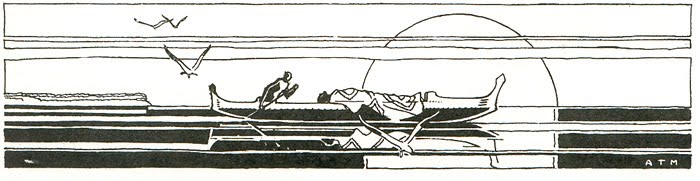
From "Paradise of the Pacific": "A fancy of ancient Hawaii, decorative of the tale of some noble warrior's shell being borne afloat to sanctified repository" by A. T. Manookian